Today marks six months in Peru - time is crazy. Six months ago I got on a plane, not entirely sure what I was getting myself into, but certain that I wanted to find out. Even with so many months already behind me, I'm still figuring out my role in my community, and discovering what being a Peace Corps volunteer means for me. But I'm enjoying the ride, including all its ups and downs, and I never regret getting on that plane.
The fact that each volunteer signs on for a set two years of service puts a funny sort of time stamp on our lives and work here. There are always milestones to mark, whether it be counting up how many months you've been at site, or counting down how many months you have left in country. To always have these frameworks of time in mind is a bit odd - in what other job do you, from day one, count down how much time you have left? - but it can also be a good and motivational force that keeps you going through tough times or inspires you to make the most of what (relatively) little time you have in your community. Six months is no small span, so today we 19ers take a moment to reflect, appreciate how far we've come, and raise a toast to all the adventures that remain.
sábado, 8 de diciembre de 2012

martes, 4 de diciembre de 2012
Peace Corps stats
This month a significant chunk of my time is being dedicated to writing my Community Diagnostic, a lengthy document that summarizes the information I've gathered about Cajabamba's economic development situation in the last three months. Eventually I will present the report to both Peace Corps staff and important members of my community, while also using my findings to help formulate a work plan for the coming year - it's kind of a big deal.
Anyway, writing the introduction this afternoon had me surfing the web in search of info about Peace Corps as a whole, and I thought I'd share some fun facts.
Anyway, writing the introduction this afternoon had me surfing the web in search of info about Peace Corps as a whole, and I thought I'd share some fun facts.
- Current number of volunteers worldwide: 8,073. About 230 of us are here in Peru.
- Current number of countries served: 76.
- 21% of volunteers are serving in Latin American countries.
- Only 12% of us work in the community economic development program.
- 62% of us are female, and 93% of us are single (i.e. not married).
- The average age of volunteers is 28 - guess I joined a little early.
Do-overs
I've come to realize that scarf-making is an excellent metaphor for work as a Peace Corps volunteer.
When you are new to the art of scarf crocheting, as I am, you are liable to make a few rookie mistakes. For example, you might buy only one skein of yarn, thinking that will be plenty for a scarf. Then, when your yarn is about to run out and your "scarf" is about as long as a nice quilt square, you'll be left to progressively work yourself into a mild panic as your search through every yarn store in town yields no matching wool. Finally the Sunday market yarn lady will miraculously produce the last two remaining skeins of deep purple yarn, saving you from having to totally scrap your scarf project - things in Peru have a way of working themselves out somehow. As a newbie crocheter, and as a new-to-site volunteer, you spend a while stumbling around, giving things your best guess, and hoping for the best. Even though odds are that you don't really get how things work on the first try, the Peruvians put up with you, and try to help you out. And you make it through.
Then you go about your business, crocheting along row by row on this awesome purple scarf project that you're super enthused about, and life is good. Peace Corps projects tend to start out this way, too: so full of potential that you can't help but be excited about all the good you can do. But then, midway through the first skein of yarn, you hold up the scarf-in-progress to admire your handiwork, and you notice that the scarf has somehow been progressively growing in width. A quick stitch count confirms: you've been adding an extra loop to each row. Since triangle-shaped neckwarmer was not the look you were going for, you proceed to un-do all but the first four rows. This is one of those mistakes you can laugh about; just brush it off and move on. Re-doing ten rows won't kill you. Like realizing post-facto that the handout you gave all your students today has half-a-dozen Spanish typos, or watching helplessly as your socio gives everyone at the meeting a highly inaccurate description of Peace Corps' economic development program - you've just got to appreciate the humor of things, and roll with what you've got.
Eventually, one of the tougher problems catches up with you. That nagging feeling you've had since row five that your scarf is just a little bit too wide to be normal? Thirty rows deep, you can now decidedly state that no, a scarf this wide just isn't going to work. This is a bummer, as you've invested a solid number of hours and now have to face the reality of a complete do-over. But, since you know in your heart there's no other option, you sigh, take a deep breath, and proceed to pull apart the entire scarf. Back to square one, you re-roll the messy pile of yarn into a neat ball, and start again. Projects in Peace Corps often don't go as planned. Whether the municipality backs out on funding, or participants say they don't have time to come to your meeting, or a teacher strike shuts down classes for a month, things happen. And even though it sucks the wind right out of your sails, you pick up the pieces, ask yourself what you can learn from this small fiasco, and start again.
But you're wiser now. You make the scarf ten stitches less wide, and you know from experience that this will be the perfect width. You've already stockpiled your yarn, and to boot you now personally know all the nice ladies in town who sell wool. You know where you went wrong, and you won't be making that mistake twice. And most importantly, you aren't going to quit. That scarf is going to get made, no matter how many times you have to start over.
jueves, 29 de noviembre de 2012
You know you're in Peace Corps when...
... you get invited to watch a cow give birth. Last week, my veterinarian friend Edwin called with a very special invitation: "Meghan, there is a cow that is going to give birth soon, and you are invited to come watch. Charge your camera and keep your phone on, because I'm going to call you when it's happening." Watching a cow be born wasn't exactly on my bucket list, but I figured, when else in my life am I going to have a chance to see this? It could be a little gory, but would definitely be pretty cool. So I told Edwin I'd be ready.
Thus, on Wednesday night when I got word that the vaca was going to give birth in the next half-hour, sitemate Jessica and I hustled out to the campo to witness the big event. Unfortunately the half-hour estimate turned into two hours, then eight hours. That's when Jess and I called it a night, figuring we'd wait for another cow birthing that wasn't at 4:00 in the morning. But, fate intervened, and when I headed back out to CEFOP the next morning for my usual Thursday class, it turned out the vaca still hadn't given birth. To boot, veterinarians Edwin and Elí had decided that the time had come to perform a c-section on the mama cow. Thus not only did I get to watch a cow be born, but I had a front-row seat to an open-air medical operation - only in Peru :) It turned out to be a fascinating morning, ending with the triumphant entrance into the world of a new calf. Here's some photos from throughout the event:
Thus, on Wednesday night when I got word that the vaca was going to give birth in the next half-hour, sitemate Jessica and I hustled out to the campo to witness the big event. Unfortunately the half-hour estimate turned into two hours, then eight hours. That's when Jess and I called it a night, figuring we'd wait for another cow birthing that wasn't at 4:00 in the morning. But, fate intervened, and when I headed back out to CEFOP the next morning for my usual Thursday class, it turned out the vaca still hadn't given birth. To boot, veterinarians Edwin and Elí had decided that the time had come to perform a c-section on the mama cow. Thus not only did I get to watch a cow be born, but I had a front-row seat to an open-air medical operation - only in Peru :) It turned out to be a fascinating morning, ending with the triumphant entrance into the world of a new calf. Here's some photos from throughout the event:
 |
| Shaving the incision area |
 |
| IV fluids - Martha the cow is not quite pleased |
 |
| Anesthesia shots |
 |
| Some intrigued local spectators |
 |
| The two amigos, ready in their scrubs |
 |
| First incision |
 |
| Pulling the uterus out |
 |
| The calf is born! |
 |
| An adorable baby boy |
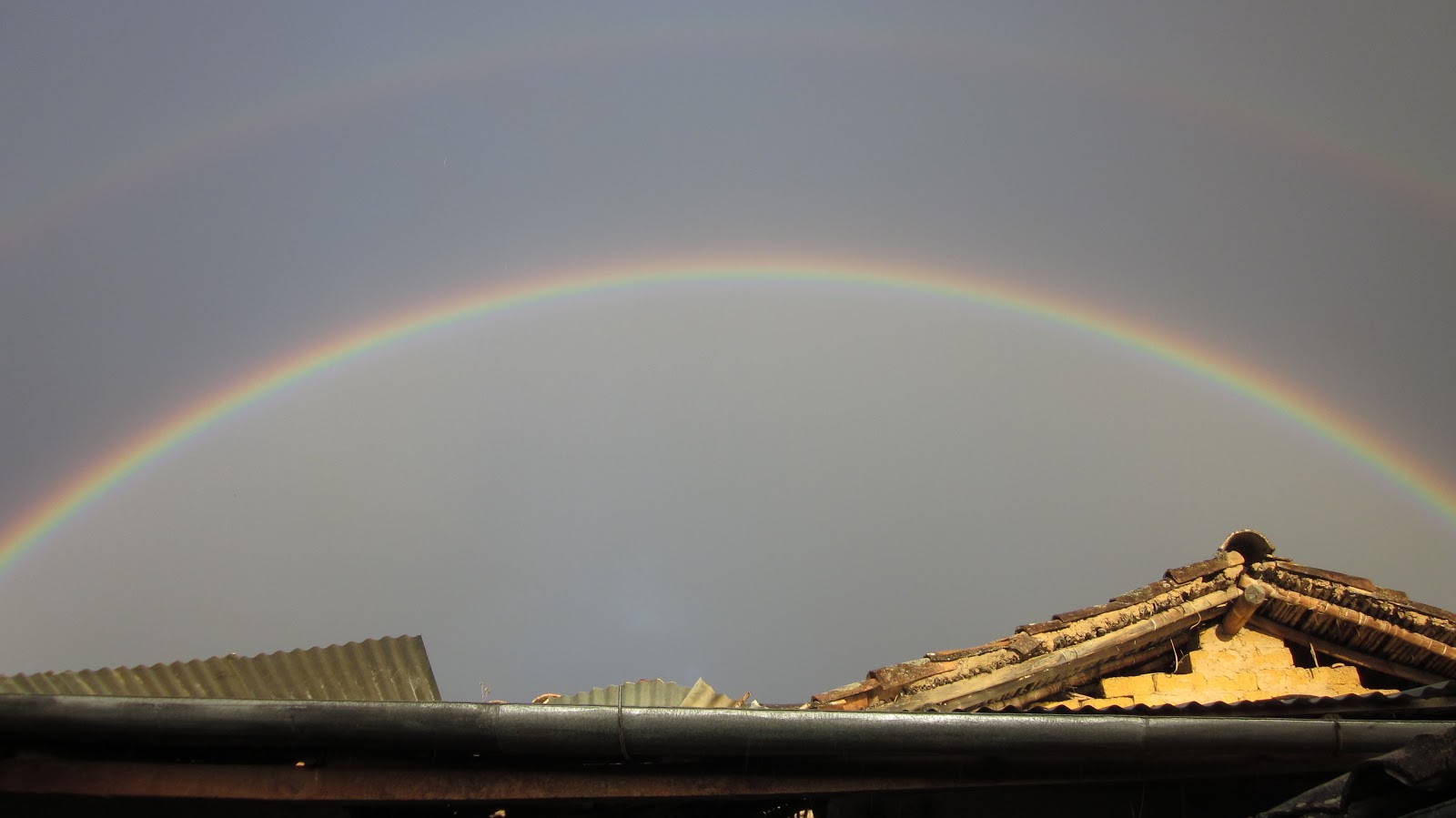
The upside of rainy season
Sometimes rainy season has its perks, like when perfect double rainbows appear over Cajabamba:

lunes, 26 de noviembre de 2012
Chan Chan
On our way back from the beach, we decided to make a pit-stop to see the pre-Columbian ruins of Chan Chan, which are located right along the highway between regional capital Trujillo and the beach at Huanchaco. We weren't really sure what we'd find, and when the bus dropped us off on the side of the highway in the middle of the desert we knew we were in for an adventure. Luckily the access road was clearly marked, so we set off on a 20ish minute trek beneath the blazing sun.

Arriving at the main ruins site, we were impressed to find a very extensive and well-preserved city of clay, including plazas, buildings, fortifying walls, carvings, tombs, maze-like walkways, and even a central oasis. Chan Chan used to be the capital of the Chimu people, who were later conquered by the Incas, and it seemed like this society had spared no expense on the city's construction (cerca 1300AD).


From snooping on a passing tour group, we later learned that Chan Chan was once the largest adobe city in the world - quite an accomplishment for a city built on sand!
A Thanksgiving miracle
Thanksgiving at the beach was awesome: good friends, delicious food, nonstop sunshine, and relaxing vacation time. Our turkey day feast was nothing short of a miracle. Steve, Chris, Jackie and I prepared the following scrumptious dishes: turkey, sautéed veggies, gravy, macaroni and cheese, mashed garlic/cheese potatoes, sweet potatoes with brown sugar, green beans, salad, bread rolls with butter, no-bake cookies, and of course some vino.


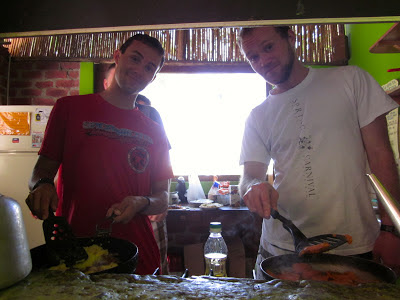
And we did all this with NO oven, only TWO working gas burners (see photo below), and for the cost of less than $14 per person. Like I said: a Thanksgiving miracle.

When we weren't busy consuming our copious amounts of Thanksgiving food, we relaxed on Huanchaco's sunny beach, made friends with the hostel's two oversize pet tortoises, who we named Crush and Louisa, and watched the sunset from the hammocks on the deck.


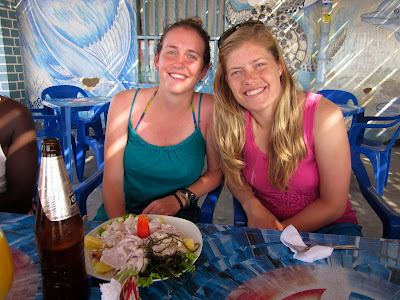
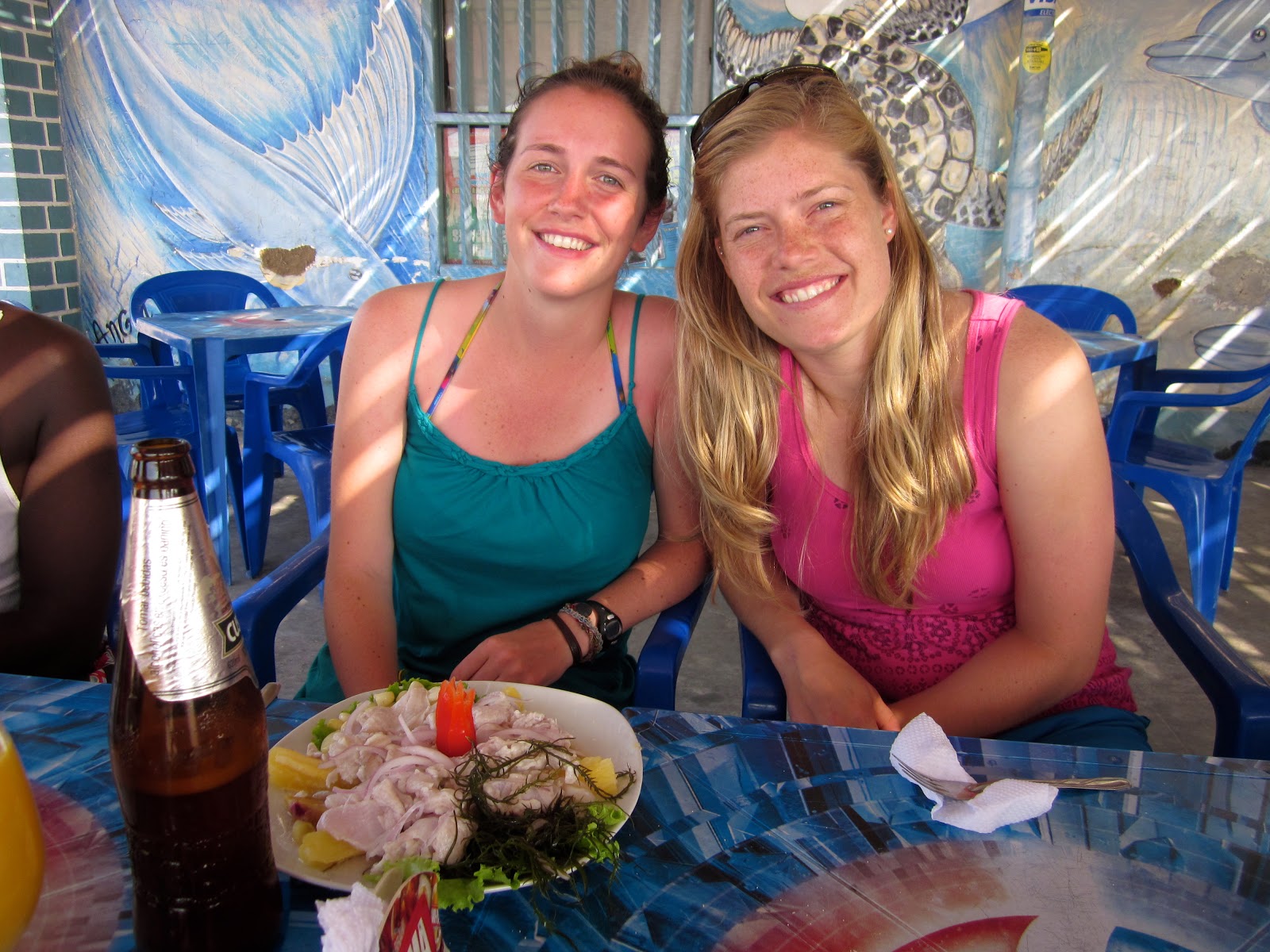
Once the turkey leftovers ran out, it was time to venture out for the Peruvian coastal staple: fresh-as-can-be ceviche on the beach-e.
At night we amused ourselves with music, cards, catch phrase, and Huanchaco's nightlife. We were a bit of a spectacle the night we brought catch phrase out to a bar with us, but everyone stares at the Americans whether or not we're shouting over a competitive beeping hot-potato-esque game, so we figured why not? :)


And we did all this with NO oven, only TWO working gas burners (see photo below), and for the cost of less than $14 per person. Like I said: a Thanksgiving miracle.

Friday morning we made sure to take advantage of an often under-appreciated Thanksgiving tradition: the morning-after leftovers brunch. Fellow 19er Tyler arrived in Huanchaco in time to help us cook up all the remainders, and we had scrambled eggs, mashed potato pancakes, and sweet potato hashbrowns - yum!

When we weren't busy consuming our copious amounts of Thanksgiving food, we relaxed on Huanchaco's sunny beach, made friends with the hostel's two oversize pet tortoises, who we named Crush and Louisa, and watched the sunset from the hammocks on the deck.


Once the turkey leftovers ran out, it was time to venture out for the Peruvian coastal staple: fresh-as-can-be ceviche on the beach-e.
At night we amused ourselves with music, cards, catch phrase, and Huanchaco's nightlife. We were a bit of a spectacle the night we brought catch phrase out to a bar with us, but everyone stares at the Americans whether or not we're shouting over a competitive beeping hot-potato-esque game, so we figured why not? :)
Suscribirse a:
Entradas (Atom)